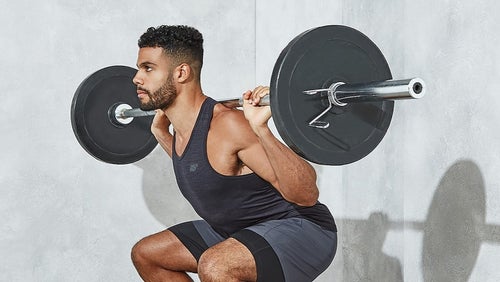
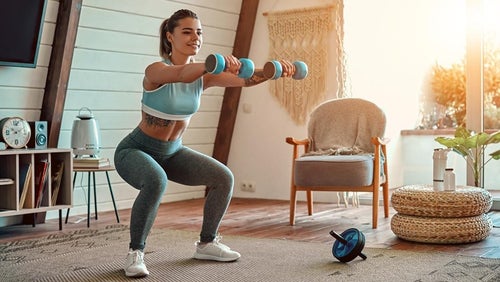
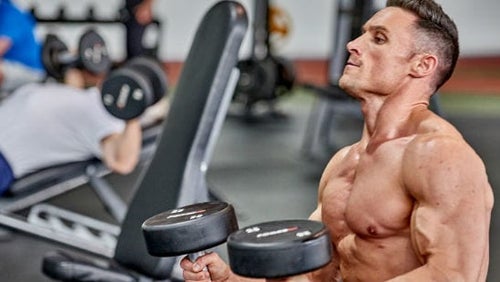
If you want to build awesome strength in your legs, this dumbbell leg workout will put you on the right path. People tend to prioritize their upper body in the gym, especially since leg workouts tend to be more intense.
But it's just as important to train your legs, whether your goals are to build muscle, lose fat, or achieve a generally toned physique. Plus, leg exercises work multiple muscle groups, including your core muscles.
This guide provides basic dumbbell exercises for legs that are simple and effective, and generally recommended as part of a balanced routine. Building strong legs and glutes will ensure a solid foundation for an athletic physique, plus improve athletic performance.
A strong lower body is also key in strength and conditioning and reducing your chance of injury in general. When training any muscle group, remember to prioritize proper form to avoid injury and maximize results.
The goblet squat can be a great alternative to squatting with a bar on your back, especially for beginners to learn the proper squat technique. Having the weight distributed in front of you presents a different challenge and will also target your abs, so remember to keep your core engaged during this movement.
Sets and reps: 3 x 8-12
Technique
Hold the dumbbell with your palms facing up (hence the ‘goblet’ part of the name), with your feet around shoulder-width apart and your chest forwards, shoulders back.
Keeping a straight back, bend your knees and move your bum back and down, so your weight is through your heels. Aim to get your bum as close to the ground as possible.
Keep your chest facing forward.
Tense your abs and push back up through your heels to your starting position.
2. Dumbbell Deadlift
There are so many different variations of the deadlift, but they all have one thing in common – they work multiple muscle groups.
Deadlifts will fry your hamstrings and glutes, as well as your core and upper back—talk about effective.
Sets and reps: 4 x 8
Technique
Place a dumbbell on its end and stand with your feet on either side of it, about shoulder-width apart.
Bend your knees and this time push your bum back to the wall behind you, instead of down (as in the squat). You should feel a slight pull in your hamstrings (on the back of your upper leg).
Keeping a straight back, with your chest forward, and shoulders back, reach for the dumbbell with straight arms.
With the dumbbell in your hands, tense your abs and stand up straight by driving your hips forward and squeezing your glutes.
Bend your knees and move your bum backwards again, and lower the dumbbell back to the floor, still keeping your back straight.
3. Bulgarian Split Squat
Single-leg exercises can arguably be tougher than two-legged exercises if you do them right. Balance can be an issue initially, but you’ll perfect it with practice. This move will work many lower-body muscle groups, including the quads, glutes, hamstrings, and hip flexors.
Additionally, because you stay in one fixed position during the movement, you may find it easier to lift a heavier weight than you would with a standard lunge.
Hold a dumbbell in each hand and stand with your back to a bench. Place your back foot on the bench. Depending on your ankle mobility, you might prefer to have your toe in contact with the bench, instead of your ankle – find what works best for you.
Alternatively, you can hold one heavier dumbbell in the opposite hand to your front leg (i.e., if your left foot is forward, hold the dumbbell in your right hand, and vice versa).
Lean forward at a 45-degree angle (this forward lean increases how hard your glutes work, in comparison to standing upright), and put all of your weight on the heel of your front foot.
Bend your front knee and lower yourself down to the ground – under control – using the front leg as a brake against gravity.
Push back up through your heel to the starting position.
Make sure all of the work is being done by your front leg, and that you’re not using your back leg to help.
Tip: If you need to strip this back, take your foot off the bench and perform a standard split squat.
4. Leg Romanian Deadlift
Similar to the dumbbell deadlift we’ve just gone through, this single-leg deadlift variation will grow and strengthen your hamstrings and glutes, with the added challenge of one leg doing all of the hard work. When performing this move, lower the weight under control and move through a full range of motion to maximize muscle activation.
Sets and reps: 3 x 10-12 per leg
Technique
Stand on one leg (starting on your weaker leg), and hold one relatively heavy dumbbell in the opposite hand to your standing leg.
Alternatively, you can hold one lighter dumbbell in each hand.
You should have a slight bend of the knee in your standing leg. Lean forward (you’ll feel a slight pull in your hamstrings, on the back of your standing leg) until your body is parallel with the floor, and bring your non-standing leg up behind you.
Stand back upright, pushing through the heel of your standing leg, driving your hips forward.
Tip: You can make this easier by placing your rear foot slightly offset to the working leg and performing the movement with additional support.
5. Walking Lunges
Here, we'll hit some different muscle fibers (type 1) than we did earlier in the workout with the heavier, lower rep exercises (type 2) for a complete leg workout.
Sets and reps: 3 x 15-20 per leg
Technique
Holding a dumbbell in each hand, step forward and bend the knee of your front leg, placing all of your weight through your front heel, and dropping your back knee towards the ground under control.
If you don’t step far enough forward, your weight will be through the ball of your foot, not your heel. If you step too far, you’ll find yourself using your back leg to help. Find the middle ground for you.
Push back up through your front heel, leaning forward at 45 degrees (as before with the Bulgarian Split Squat), and bring your back foot forward to meet your front foot. Swap legs.
Glute bridges train hip extension by lifting the hips from the floor while the upper back stays grounded. This makes them an effective way to target the glutes without loading the spine.
Sets and reps: 4 x 20
Technique
Lie on your back with your feet flat against the floor and knees bent.
Place a weight across your hips.
Engage your glutes by squeezing them and lift your hips off the floor, driving them up towards the ceiling. At the top of the movement, make sure your body forms a straight line from your knees to your shoulders.
Pause at the top of the movement and squeeze your glutes as hard as you can, hold for 1-2 seconds, and then lower back down slowly to the starting position.
Once complete, switch legs and repeat.
7. Calf Raises
Elevate your dumbbell leg workout by not only working the upper leg, but the lower leg too. Your calves will really feel the burn with these dumbbell calf raises.
Standing opposite the calf raise machine, set the pads for the shoulders at about eye level. With feet shoulder-width apart and toes facing forward, crouch and place yourself under the pads.
The front or ‘the balls’ of the feet should be on the base of the machine with the heels dropped off the end.
As you promptly exhale your breath, elevate through your ankles and heels until your calf is fully contracted and extended. At this point, you should be emphasizing a flexion in your calves.
Hold this contraction and squeeze for a brief second.
Throughout this part of the movement, your legs should not be moving, and all emphasis should be placed on the calves.
Once the calves are fully extended and you feel a serious contraction, lower the weight back down slowly to the starting position.
As you lower the weight to the starting position, inhale your breath. Both the lowering and breathing should be done in a slow, controlled manner.
Lower the weight until the calves are fully stretched.
After completing an internship with Myprotein, Emily returned to university to finish her Bachelor of Science degree in Business Management and Marketing.
With experience in lifestyle writing, Emily aims to entertain and educate through her work. Her focuses include recipes, real and inspiring stories, and working with writers to help provide easy-to-digest evidence-based research.
Her work on recipes has been previously featured in The Supplement magazine, with a particular focus on high-protein, nutritious meals, plus advice on how to properly fuel your body.
Outside of work, Emily’s top priority is food. She’s a self-professed star baker and a connoisseur of all things baked. In her spare time, she’s either cooking up a storm, our looking out for the opportunity to try out Manchester’s newest restaurants. But as a huge fan of carbs, if it’s not pasta or pasta-adjacent, she’s not interested.
If she’s not in the kitchen, she’s tucked up with a book for an early night, or you’ll find her in the gym working up a sweat. Afterall, all those carbs require quite the appetite.